Collecting

susan-surface

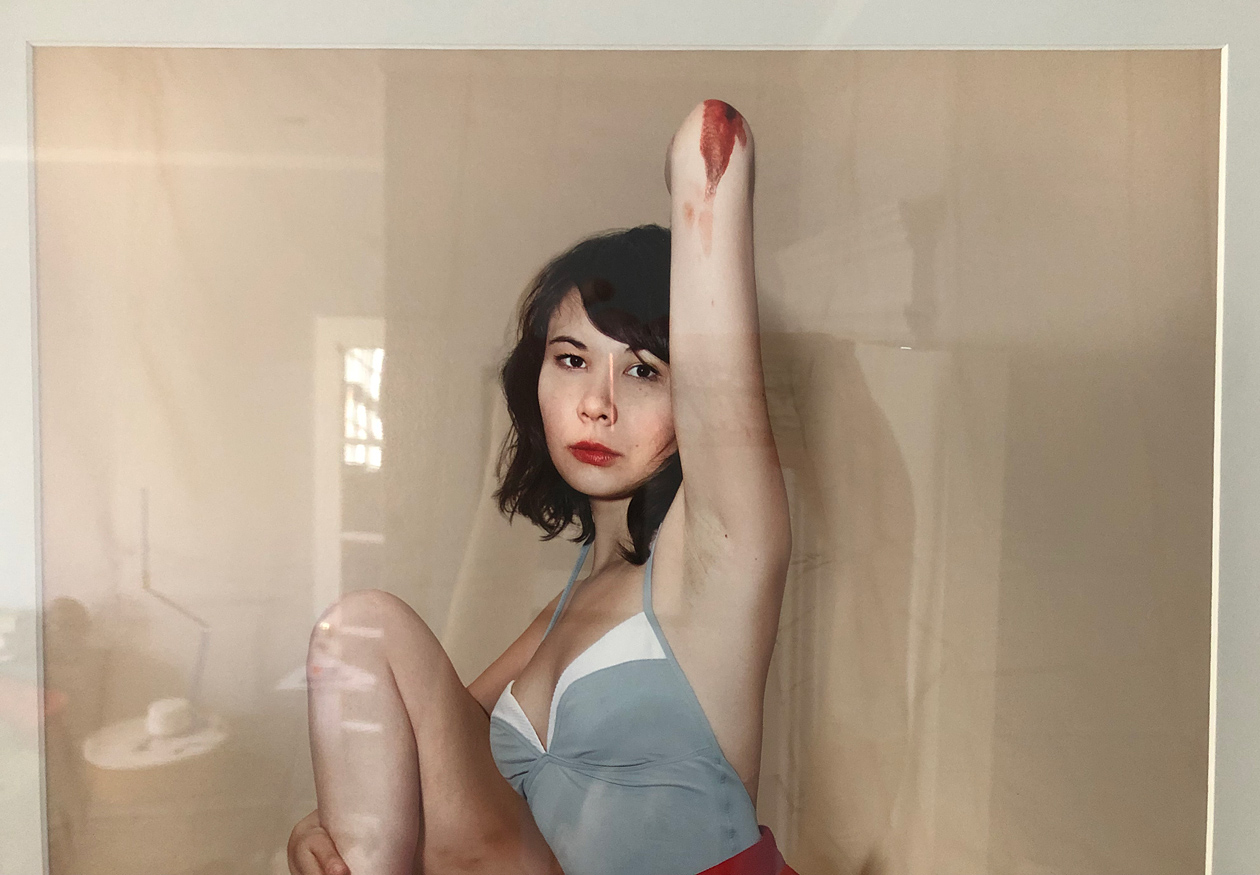
I had breakfast with photographer and Yale architecture student Susan Surface today. I saw her presentation at Architecture for Humanity’s PechaKucha fundraiser for Japan in New Haven a few weeks back. Susan is an amateur (professional?) bull rider as well as a full time grad student. She’s been transforming the pain of being bucked off a bull into an art project. After a rodeo event, Susan documents her bruises in delicately posed self-portraits that are colorful and alluring yet alarming (I like alarming). I was enthralled by her photos, both these self-portraits and the images she’s taken of the bull-riding community, not to mention by the guts this woman has! How many young women do you know that ride bulls? (And she probably weighs about 100 pounds.) Having successfully guessed her email address, I decided to ask her if any of her portraits were for sale, and now I’m about to collect two of her photographs. It’s pretty neat-o.

For Yayoi

dots1

dots2

dots3

I’ve long been a fan of Yayoi Kusama. She’s an important Japanese artist whose work resonates with the specific compulsions of modern women worldwide. Her dots series, installations covered in dots—on walls, on people, on trees, on things—are mesmerizing. Using this simple technique, Kusama creates these eerie immersive environments. For me, they represent certain obsessions: obsessions with the body and its perception, its shapes and holes and uses; an obsession with control. The images above of flower petals on the ground from the early weeks of May reminded me of her.

Kusama did much of her seminal work in New York, but returned to Tokyo in 1973 and has been living in a mental institution almost ever since. Paranoid schizophrenic, I believe. Many of her works are inspired by her hallucinations. There’s a great picture of her Self-Obliteration by Dots, a still of a performance from 1968, in BOMB Magazine’s interview. Another iconic set of works is the accumulation series, wherein Kusama glued protuberances to cover entire objects and whole surfaces. She posed with one of these pieces, Accumulation No.2, once perhaps a couch, and MoMA has the photo. It was printed on the Kusama Retrospective poster back in 1998, “Love Forever: Yayoi Kusama, 1958-1968.” I put it up in my father’s former studio for inspiration. I thought of her more as a baby doll back then, looking so coquettish. Now she uses that same silhouette as a brand on her website.

Smoking? What’s that?

airplane

A sign of the times: smoking is no longer considered a menace on domestic flights, rather, the menace to air travel is… electronic devices. This small Delta jet took me from Hartford to Minneapolis on my way to Lincoln, Nebraska. I was so tickled with the sign commanding “turn off electronic devices,” particularly since the directive is placed right next to the icon for “fasten your seat belts,” that I violated the rule so as to snap this photo with my iphone. (It was on airplane mode.) Did signage designers just figure they should use the space for something?

NCBDS 2011 in Lincoln, Nebraska

welcome
Conference welcome sign
sheldon
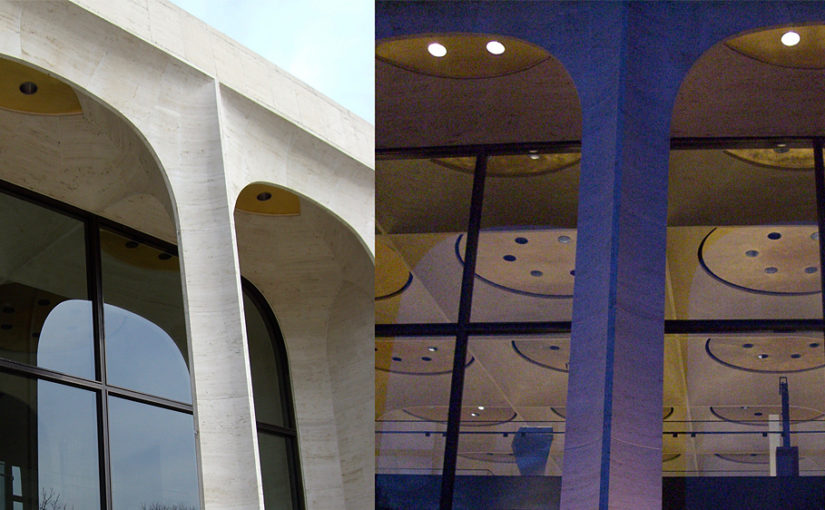
Philip Johnson’s Sheldon Art Museum
nebraska
The stipulation of no guns on the museum’s door

I had a wonderful time at this year’s National Conference on the Beginning Design Student (NCBDS) at the University of Nebraska in Lincoln. The energetic Peter Hind was the conference chair. I was fortunate to meet Peter at last year’s conference, held at the University of North Carolina in Charlotte. I just decided to join his dinner table, not knowing who anyone was, since I came to the conference alone as an observer. I was lucky enough to find myself sitting with Peter and the 2012 conference chair, Jodi La Coe. The title of this year’s NCBDS, “Beginning of/ In the End,” will be mirrored in next year’s conference, “In the End/Beginning of.” This is Peter and Jodi’s conceit and a nice way to tie the two conferences together—2011 focused on teaching the principles of sustainability during first year, and 2012 will be about life-long learning.

Peter scored a coup, I think, inviting Allison Arieff as the keynote speaker. Arieff is the sassy and sharp former editor-in-chief of Dwell magazine, a leader in its socially relevant hay day, who now writes an “opinionator” blog about architecture and design for The New York Times. (Dwell now sadly acts as more of a series of advertisements than as a critical voice about design.) Arieff has a crisp and straight forward style that allows her to cut through a lot of the jargon that normally bogs down architectural discourse (like the word “discourse,” for example). She posed some troubling questions to the audience, like how can professional designers promote walkable communities, for example, in the face of fierce right-wind rhetoric that positions multi-family housing as un-American? (Arieff had no answer to this; she just wanted to point out how polarizing political issues regarding land use planning have become.)

gallery
panam
paperrings
Images of Nebraska: student work in the gallery

The conference sessions I attended sparked a lot of ideas for me about teaching, and that’s what the NCBDS is about: sharing ideas and getting feedback from faculty who care about pedagogy. The only confusing bit it that not all papers are about first year. Others are about the first year of graduate school or about design pedagogy in general. There are occasional conferences and symposiums about teaching architecture, but this is the only national annual one, and presenters have suggested widening the title to reflect the true diversity of topics. (There was a 2008 conference in Leeds, UK: International Perspectives on Art and Design Pedagogy; a 2003 conference at MIT which produced this useful bibliography on the pedagogy of architectural history and theory; and this winter Princeton held a symposium titled, Teaching Architecture, Practicing Pedagogy, the proceedings for which have yet to be released.)

I would prefer that the conference be strictly about first and second year undergraduate architecture education, since this is a special time for students and a period of great responsibility for faculty who are—really, truly!—moulding young minds. Just as adults fondly remember their first or second grade teacher, architects recall their first studio instructor and internalize the values that person transmits. This is how dynasties of thought flourish. My first studio professor was Thomas Chastain, who was educated at MIT by such luminaries as Gyorgy Kepes. Kepes was a Hungarian born artist, architect, and design theorist who investigated such ideas as phenomenal transparency, later co-opted by Colin Rowe. Kepes was interested in how designers create a set of rules, in how the visual mind works, in patterns in the city, and in links between science and arts—all topics that are in turn important to me, and Professor Chastain’s influence is the likely cause. By third or fourth year, this type of influence on a student’s world-view has diminished, along with the importance of the professor’s ability to clearly illustrate their thoughts on the nature of design. A beginning design conference, therefore, is irreplaceable, and suffers when diluted.

Some ideas and information from the conference sessions:

  • from Catherine Wetzel, IIT: tape out plans of case studies full scale on the floor
  • from Jennifer Wall and William Taylor, University of Oregan/Portland State: if you soak plaster blocks for 48 hours, you can then carve them on a cnc mill without copious amounts of dust that mess up the design
  • from Bradley Walters, University of Florida: 26% of the total US waste stream is linked to construction; 12.85% is from demolition, 10.86% is from renovation, and only 2.29% is from new construction
  • just my own idea: a lip dub exercise; students take a week to film a lip dub, then another week to draw and map it; teaches about sequencing events and marking time in 2D space
  • from Michael McGlynn, Kansas State: architecture education is best realized through integration between structures and studio courses. “Structure is architecture.” One must begin with NAAB’s desired learning outcomes and work backwards. However, the conceptual framework of theory is critical: the scaffold of architectural education is built by theory—frames the questions, the why’s of the debate.
  •  just my own idea: instead of lots of projects, give first year students fewer projects with more connecting parts

More about my own session in the next post.

Very superstitious… writing’s on the wall

13thfloor

Very superstitious, writing’s on the wall,
Very superstitious, ladder’s bout’ to fall,
Thirteen month old baby, broke the lookin’ glass,
Seven years of bad luck, the good things in your past!

When you believe in things that you don’t understand,
Then you suffer!
Superstition ain’t the way.

Stevie Wonder. “Superstition.” Talking Book. Motown Records, 1972.

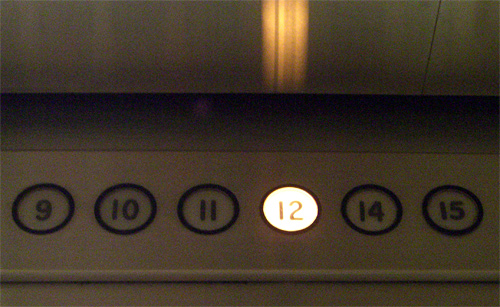
This photo was taken in the elevator of the “gold building” in New Haven, CT, on Church Street—you know, the one with the gold-tinted glass cladding. Every city’s got one. This gold building has a mezzanine, so the 12th floor… is actually the 13th.

(Did you listen to the link? Here’s more Stevie Wonder on Sesame Street.)

My ACSA session

placards

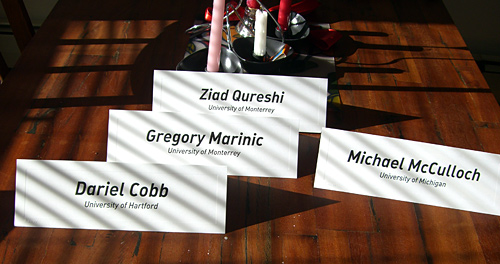
As mentioned in my last post, there were four speakers in the Northeast Fall Conference session at the ACSA national conference in Montréal, the session I moderated on Sunday morning. Here’s an image of our placards—all except Onezieme’s, who like me wanted to keep his placard. They make one feel rather official, in contrast to the first-name-only name tags ACSA handed out, which were rather casual. The speakers presented in the following order:

  • Gregory Marinic and Ziad Qureshi, University of Monterrey
    “Suburbania: Monterrey, Urban/Suburban Dichotomies in Northeastern Mexico.”
  • Michael McCulloch, PhD student, University of Michigan
    “Inside Ford’s Garden City: Social and Spatial Logistics of a Hybrid Suburbanity.”
  • Onezieme Mouton, University of Louisiana at Lafayette
    “Let it die. Who really gives a damn anyway?”

I’m going to discuss them in reverse order. These three papers represent not only a range of views about urban culture, but the speakers themselves typify three different ways of being an architect. Onezieme Mouton is a design-build practitioner who invested his own funds in the renovation of two small buildings in Abbeville, LA, his home town. They border Madalen Square, part of Abbeville’s downtown historic district. The renovation of a third empty building, Frank’s Theater, has become his personal mission. Mouton established a non-for-profit, the Allumé Society, in order to raise funds, rally community support, and enable critical government partnerships. His paper explores the role non-profit organizations have to play in bridging the gap between designing and building, and between educational, community, and governmental resources. Onezieme is rare in his combination of earnestness and personal sacrifice. He reminds me a bit of Emily Pilloton, who moved to rural North Carolina to teach high school students about the transformative power of design. Pilloton, who was a TED presenter in 2010, would probably like the term Onezieme is trying out to describe community-oriented design as a combination practice of social justice and economic engine: “Quality-of-Life-itecture.”

Michael McCulloch, who goes by Mick, is an architect and educator currently getting his PhD at the University of Michigan. He’s a Detroit native, and his paper explores the role of race, class, and religion in the residential divisions of suburban Detroit, specifically around the Ford factory. It’s really quite remarkable to read how tightly Ford managed to control the social habits of its workers, sending minders into their homes to see if they were wasting their wages on drinking and carousing (if they were, wage bonuses would be docked). This was all part of trying maintaining the neighborhood as an upper middle class Anglican community, even against the influx of diverse workers with distinctly different social values and cultural practices. Mick is an architect like me, one who wants to pull back the curtain on architecture’s past and reveal whatever truths have heretofore been ignored—like the immense role racism and other prejudice has played in shaping the physical environment. It seems that most social sciences have confronted this issue head on. I feel architecture, a profession which is itself still far from diverse, hasn’t.

At some point during the first presentation I wrote down, “suburbia is the physical manifestation of imagined cultural desire.” This seems particularly true in the case of Monterrey, Mexico. Gregory Marinic and Ziad Qureshi had a lot to say about the different iterations of this desire, expressed through a combination of literal architectural translations, transpositions, and outright copying. They showed Monterrey’s miniature version of the ice rink in Houston’s Galleria (a mall), a micro-zócalo modeled on Mexico City, moderne apartment condos, and highrises that imitate recent work in Shanghai. Monterrey, I learned, has a distinct cultural and ethnic identity within Mexico given its dramatic landscape, its proximity to the United States, its wealth, and a strong historical German influence (similar to nations in South America like Argentina and Chile). One’s just as likely to hear techno music on the street as anything from La Raza. Gregory and Ziad (/zee-ahd/) use case studies as the primary vehicle of their scholarship, which seems very productive. They gave two talks as ACSA national, and I hope their collaboration will continue even though Gregory is moving to the faculty at the University of Houston.

Thanks to all of them for a great session.

Read part 1 of this post!