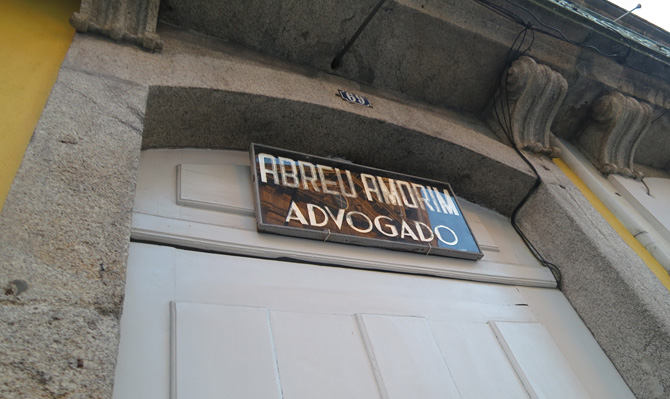
Art Deco typography is ubiquitous in Portuguese cities. In many ways, it seems that the commercial areas of Porto and Lisbon ceased to evolve aesthetically at the moment António de Oliveira Salazar became President in 1932. His corporatist authoritarian government ruled until 1968. I’m very interested in the “lusotropical” Portuguese colonial project as part of my southern African research. This semester I’m writing about Brazilian photographer Angélica Dass and her Humanae project, matching the skin tones of her numerous subjects with pantone chart colors. More on that text soon… in the meantime, enjoy this font of fonts.
It’s the end of the spring semester and I am working to finish my final papers. There are three of them. I’ve completed one, concerning Frantz Fanon’s 1961 text The Wretched of the Earth, and am about to begin the next. It seems all I do is eat, sleep, and write—and on Sundays I watch Game of Thrones. Nothing can keep me from Game of Thrones.
I was struck by a line in an article I read for my Harvard class, “Modern Speech and Other Kinds of Testimony,” by historian Megan Vaughan. The class, Themes in Modern African History, is taught by the formidable Caroline Elkins, who is generous with her time despite her demanding schedule, for which I am very grateful. The article is about the slippery nature of historical consciousness, and the ways in which the historian can unwittingly manipulate her subjects’ “identity.” Vaughan is interested in the missing pre-history of the Creole community in Mauritius, of which she writes:
“Creole intellectuals make the very valid point that their history begins on the island—their origins lie in métissage, in creolité itself, and not in a mythic origin moment which came before.”1
This sentence resonates with my own struggle to decipher and iterate my own historical identity. Like many Americans, I like to delve into the various family histories of past generations, which extend to many different ethnic and geographical origins. Yet despite the “truth” of this mixing, it is always assumed I have a European origin, and further it is assumed that I will myself have chosen a preferred ethnicity with which to identify. In the quote above, there is freedom: forget the past; you’re an American, with all the mixing that implies.
The Second Life of Kiluanji Kia Henda’s Afrofuturist Critique
(This is the first bit of a paper I wrote for my methods class in fall, 2013)
African artists born to a post-independence continent,[1] curiously placed in the temporal limbo engendered by their new nations’ violently dynamic notions of future and past, are socially empowered as image-makers to realign, reshape, and rename the world. The African artist’s process is an enactment of his nation’s negotiation with modernity; the artist is an “historical agent capable of representing the modern condition in which he is working.”[2] Using methods similar to Dadaist bricolage, Afrofuturism seizes upon this chronological purgatory as a site for uncanny cultural remixes. Science fiction narratives offer a compelling populist opening to such rewritten cultural autobiographies.
In Spaceship Icarus 13 (2008), Angolan artist Kiluanji Kia Henda (born 1979, Luanda) harnesses Afrofuturist memes to present a vision of the future based on a reimagined past, channeling an unlikely combination of satire and utopianism, irony and hope. Spaceship Icarus 13—an architectural model, a story, and a series of eight photographs—”documents” the creation of Africa’s first space base and humanity’s first mission to the sun. Henda’s spaceship is a reappropriated item of totalitarian kitsch,[3] a late 1970s era Soviet-designed mausoleum for Agostinho Neto, Angola’s Marxist-leaning first president. Within this mausoleum-cum-spaceship, enhanced in Henda’s narrative by icons of American consumerism and Angolan devastation—Budweiser and diamonds—the artist sends Neto’s ashes up to burn. The violence of this second destruction, from ashes to ashes, is both piercing and poignant. It encapsulates Henda’s artistic critique of Angola’s long civil war, its lost human potential, and its current political and economic climate.