The architecture honor society Tau Sigma Delta paid my way to the Association of Collegiate Schools of Architecture national conference this month, which took place in snowy Montréal, March 3 to 6. The University of Hartford has launched its own ΤΣΔ chapter, the “gamma nu” chapter, and will start recruiting members later this year. (I’m the new President.) I was not a member of the honor society myself, and I realize now that I may not have been eligible—only the top fifth of the student body can join. I often tell my students, in response either to their complaints or their anxiety, that I never received an A in studio. I’m not ashamed to say my highest studio grade was an A- with B+ being more common. (This was back in college. My graduate school courses were pass/fail.) When I look back on the work I did, I’m surprised my grades were even that good. Steep is the design learning curve.

The conference itself, Where Do You Stand, was characteristically multivalent. How could a national conference not be? Here is a description of the theme:
This demand for a wider agenda for modern architecture, introduced to the discipline in the 1950s and followed by Postmodernism’s demands for greater diversity, has left the discipline open—wide open—perhaps too open… architects are now not only free, but required to interpret and, indeed, choose their position relative to this expanded field. With such choice comes the responsibility to ask: Where Do You Stand?
In Saturday night’s keynote address, Mason White (of Lateral Architecture) talked about the dilution of the terms “architect” and “designer.” Apparently the business community has grabbed onto the concept of design, though I’m not sure in what capacity; either regarding organizational structure or some other aspect of a typical business plan. White notes that as the discipline opens to embrace foreign concerns from other fields, the definition of what architects do becomes confused, even at the linguistic level, in popular culture. This isn’t new; it’s been a trend for decades, as the quote above suggests. I recall being pleasantly surprised at the scope of the discipline when I started college. As the world gets more complicated, so does everything else. It’s the logical response of an intellectually active field. I don’t think it hurts architects, except to the extent it becomes more difficult to explain our work and why someone should pay for it.
Conference sessions took place Friday, Saturday, and Sunday. I missed the Friday sessions, during which two former classmates presented papers, Fred Scharmen and Molly Steenson. Molly is a PhD candidate at Princeton, and Fred is a practitioner teaching at Morgan State. I had planned to see them speak, but was delayed by traffic at the US/Canada border. I was also totally exhausted by the 7-hour drive. I used to make 6-hour drives between Berkeley and Santa Barbara quite often, but that was a decade ago.
Aside from ΤΣΔ, another big reason I wanted to attend the conference is that I signed up to moderate the Northeast Fall Conference session, a greatest hits parade of papers from our October conference. The session didn’t take place until Sunday, in the very last time slot, and most everyone had already bolted for the airport. We had maybe 6 audience members max and it dwindled to 2 by the session’s end. We followed the West Central Fall Conference session, which coincidentally included three speakers I knew: Elijah Huge, Jesse LeCavalier, and Ed Mitchell. Eli is a Yale grad who teaches at Wesleyan, Jesse and I went to college together, and Ed is a professor at Yale. They all had excellent papers, of course, unrelated thematically because each was taken from a different topic session. That made the presentations more interesting, almost like a Pecha Kucha event. Eli talked about the architecture of emergency and urban catastrophe, in particular James Steele Mackaye’s designs of folding “safety chairs” installed in theaters, meant to prevent the injuries incurred in stampedes by clearing the way to the exit in case of fire. Jesse talked about Bentonville, Arkansas, the corporate home of Walmart, and it’s bizarre infrastructure patterns. He compared it to a technoburb, but with special “vendor consulates” to Walmart HQ, and a surprising density of small airports. I’m going to have a hard time describing what Ed talked about as it was intellectually dense, and I think I took more notes on his offhand comments, like that the hotel room in which we were sitting was a symptom of urban/suburban spatial problems, with its ridiculous carpet and poor lighting, its rows of computer desk chairs, and the sound of applause leaking through the partition. The paper was titled “Up in the Air,” after the movie, and seemed like a lament to a profession that’s lost itself. Ed talked about architecture’s three models: science, populism, and aesthetics, and concluded that none has any real power to influence built space because built space, as capital, is controlled by corporate interests. Why negotiate when the outcome is pre-scripted? We’ve lost both the city and the authority to define it, he said, and what remains is a nostalgia for architecture’s past representationalism. (Ed, if you read this and I’m way off, I apologize.)
My own session had four speakers:
- Gregory Marinic and Ziad Qureshi of the University of Monterrey presented “Suburbania: Monterrey, Urban/Suburban Dichotomies in Northeastern Mexico.”
- Michael McCulloch, a PhD student at the University of Michigan presented “Inside Ford’s Garden City: Social and Spatial Logistics of a Hybrid Suburbanity.”
- Onezieme Mouton, from The University of Louisiana at Lafayette presented “Let it die. Who really gives a damn anyway?”
I will talk about their work in detail in my next post.
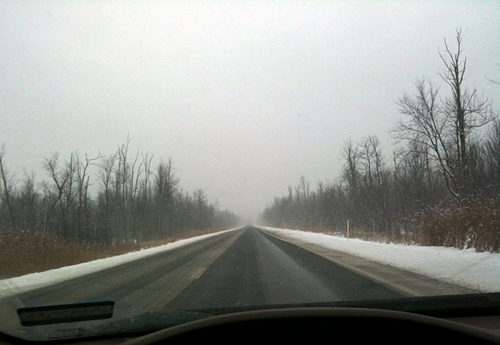
Notes about the images above. The first is a view from my car on the scary, snowy drive back to Connecticut on I87 from Montreal. The next is the scene in a packed session room featuring a conversation between Martin Bressani and Alberto Peréz-Gómez, both of McGill. It was moderated by Mark Jarzombek, of MIT, who exchanged his seat on the panel for this role since Saundra Weddle was seemingly absent. I entered the room after the session started, so I didn’t hear the explanation concerning this switch. My lateness also explains my view of the the sea of black backs from the floor, the second image. The title of the session was “JAE Beyond Precedent,” but degenerated into a petty debate about terms, like the true definition of “digital culture.” Is digital culture “one’s and zero’s,” as Peréz-Gómez said, or is it the entire system of social interactions staged around digital platforms, as Bressani countered? I know my friend Molly would have a lot to say about this—she was there in the audience, and was one of the few people able to ask a question. Another question came from a woman incensed over the use of the term “scale,” who walked up to the front of the room to confront the panel up-close. They had to tell her the question was over (after maybe 10 minutes addressing her points and listening to her follow up questions) to get her to go away. That’s one of the most annoying things about conference questions, or even lecture questions: that audience members feel they’re more qualified than the invited speakers to talk about a certain topic, and are indignant. The “questions” are really a platform for them to display their own intellect. That would be more tolerable if these intellects were really as grand as advertised, but often they’re not, and it wastes everyone’s time. The final image was taken by my phone as I jostled around trying to look professional sitting on the ground in a dress, one leg bent and one extended, since sitting cross-legged was not an option.
